
Sooner or later, every growing Pinterest blogger asks the question: should I start a second account? Sometimes the idea comes from ambition — a new audience to reach. Sometimes it comes from frustration — the first account feels stuck, and a fresh start looks easier than a fix. Here is the honest rule behind starting a second Pinterest account safely: a second account multiplies whatever your first account already is. Started on top of consistent outbound clicks, it becomes a genuine growth lever. Started as an escape from weak results — or worse, from a restriction — it doubles your workload and your risk. This guide covers when the timing is right, and how to set the second account up so the two never trip over each other.
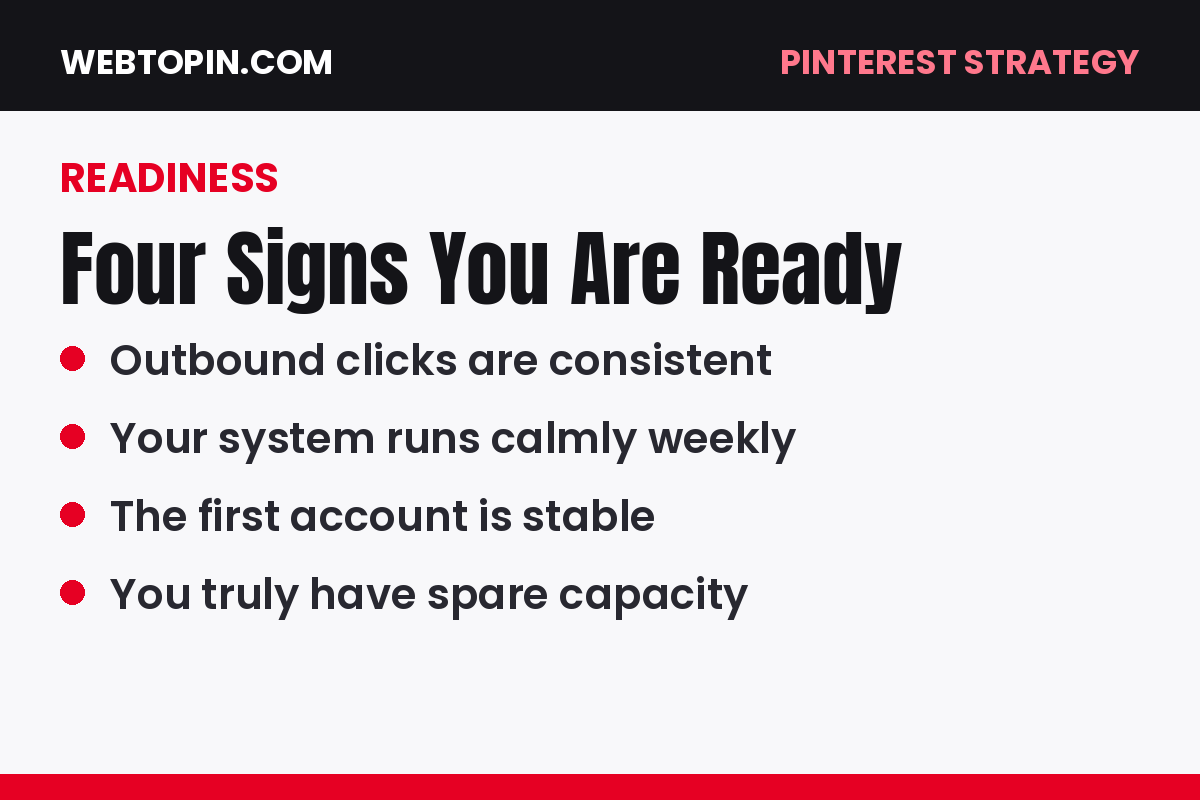
The Readiness Test: Four Signs You Are Actually Ready
Run this test honestly. All four should be true before you open anything new:
- Consistent outbound clicks: your first account sends real traffic to your blog week after week — not one viral spike, a pattern
- A stable routine: your publishing system runs without heroics, so a second account will not starve the first
- A distinct reason: a clearly different audience or angle that deserves its own boards and voice
- A clean record: no active warnings, blocks or restrictions on your existing account or domain
If the first sign is missing, the answer is not a new account — it is better topics, better pins and more time on the one you have. Pinterest rewards depth of signal from an account; splitting a weak signal across two accounts gives you two weak signals.
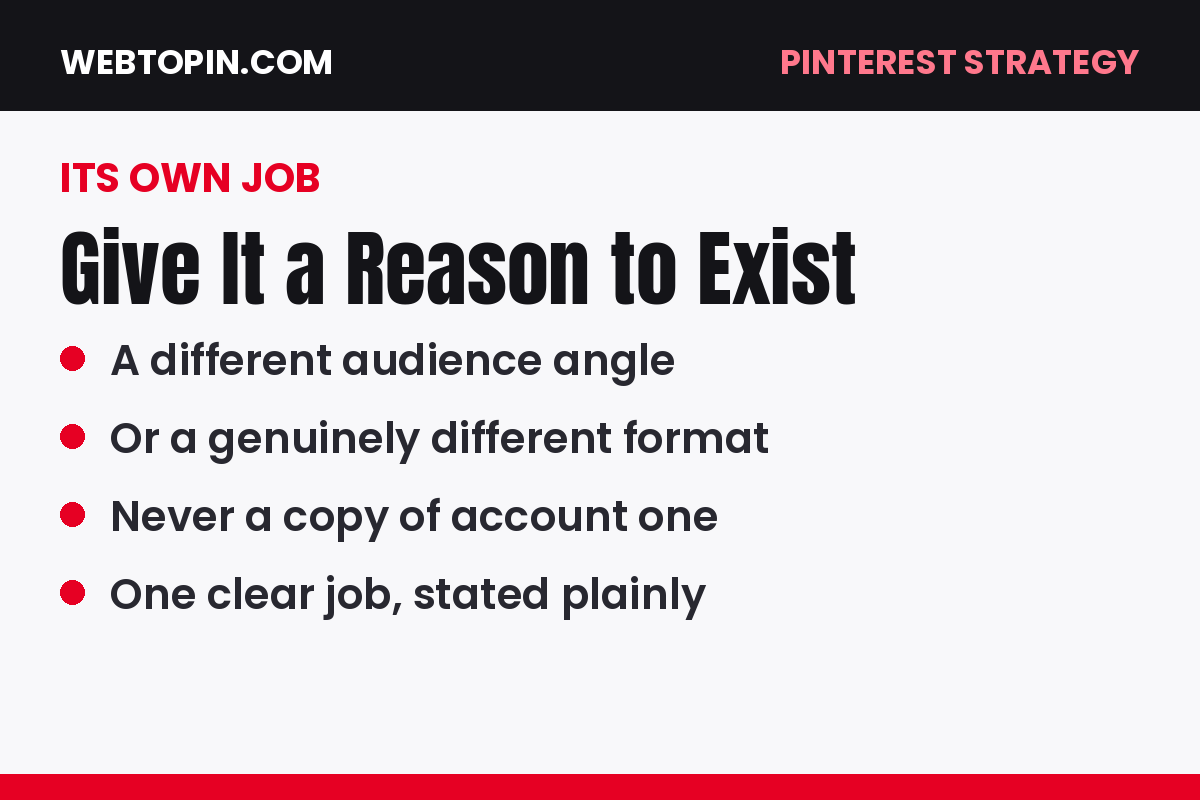
Give the Second Account Its Own Job
The safest second accounts are not copies — they are specialists. Decide, in one sentence, what this account exists for: a different audience inside your niche (aimed at a different reader), a spin-off topic your blog genuinely covers, or a different content angle on the same articles. That sentence drives everything else: its profile description, its board list and its pin designs should all look like they belong to a related but distinct publication. If you cannot write the sentence, you do not have a second-account strategy — you have a duplicate, and duplicates are what spam systems are trained to notice.
This portfolio way of thinking is the heart of Module 12: Scaling and Portfolio Growth — growth by adding focused properties, each with its own audience, rather than by pushing one account harder and harder.
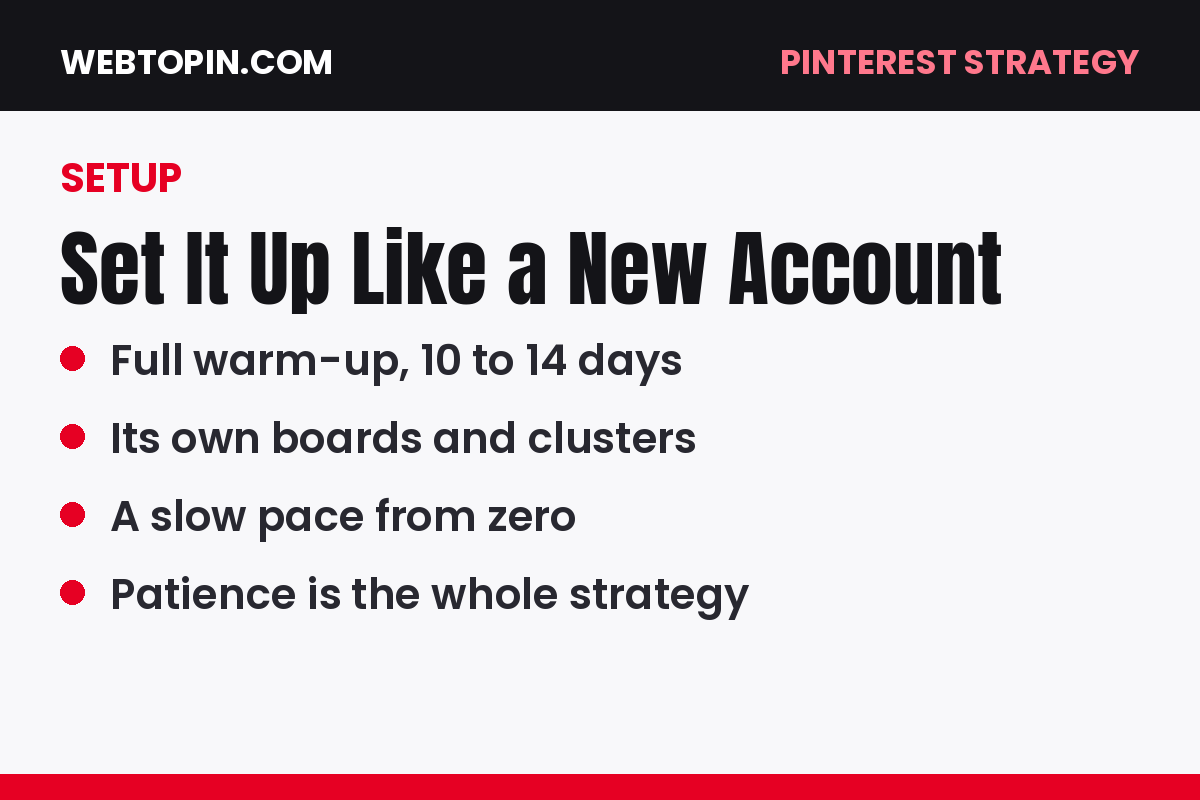
Set It Up Like a New Account — Because It Is One
Your reputation on account one does not transfer. The second account goes through the same birth process as any new account:
- Create it with its own profile details and a complete, audience-specific bio
- Build its boards from its own topic map — keyword-named, clustered, not copied board-for-board from account one
- Warm it up gradually with normal browsing and saving before pinning at any pace
- Start pinning slowly, quality first, and let its own trust build over weeks
This feels slow. It is also the safety. A second account that behaves like a two-year-old account in its first week is the single most suspicious pattern you can create.
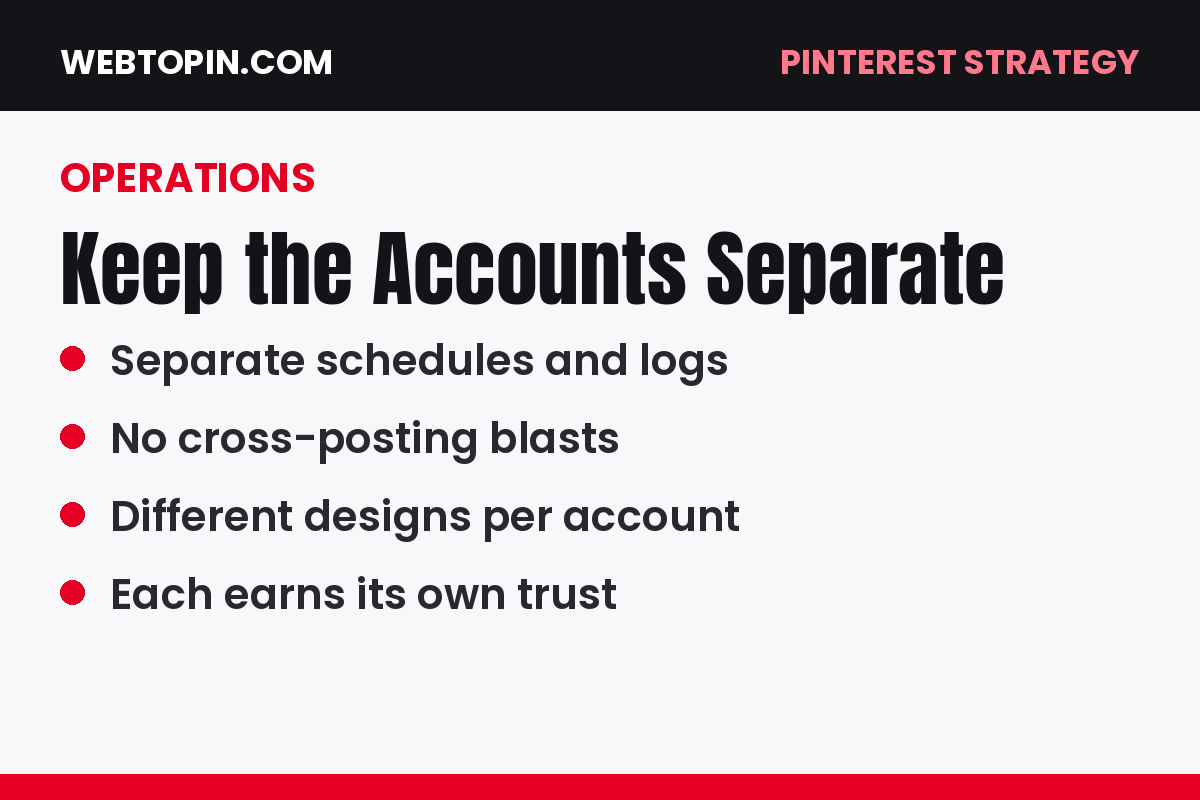
Keep the Two Accounts Operationally Separate
Separation is what turns “two accounts” from a risk into a portfolio. In practice:
- Different content emphasis: each account leads with its own topics and boards, even when they occasionally point to the same blog
- Fresh pins, always: never publish the identical pin image and text to both accounts — create a new design and new copy for each
- Staggered rhythms: the accounts publish on their own schedules and paces, not in mirrored bursts at the same minute
- Separate tracking: log each account’s clicks and growth separately so you can see which one earns its keep
Both accounts may link to the same website — that is normal for a portfolio — but each should look like an independently run publication with its own reader in mind.
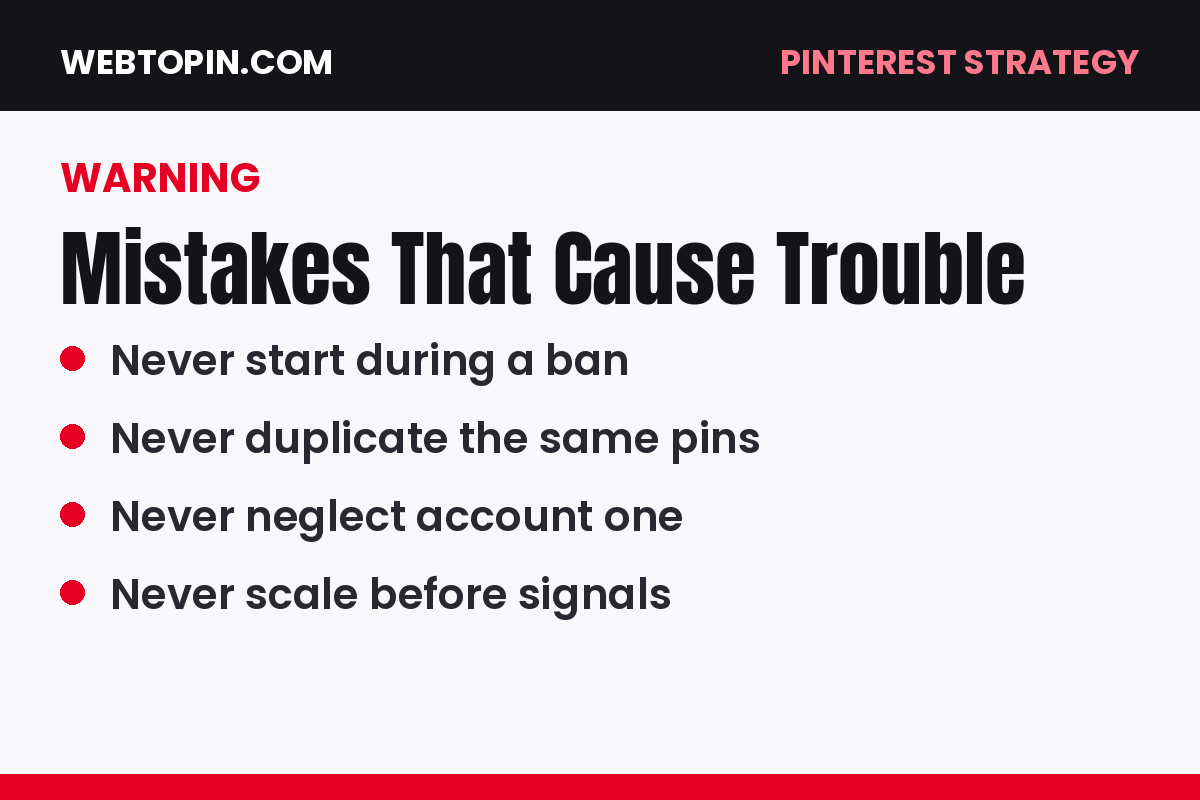
The Mistakes That Get Second Accounts in Trouble
Mirroring. Copying every pin, board and description across both accounts. It reads as duplication because it is duplication.
Escaping. Opening account two because account one was restricted, throttled or blocked. Restrictions follow behaviour and links, not usernames — and the new account usually inherits the problem plus a fresh one. If you are in that situation, recovery comes first; our recovery checklist is the right place to start, and Module 13: The Recovery Playbook explains why a clean record is a precondition for scaling.
Starving the winner. Splitting your best topics, best designs and best hours across two accounts so that neither reaches the consistency your first account had alone. Add the second account only when the first can spare the fuel.
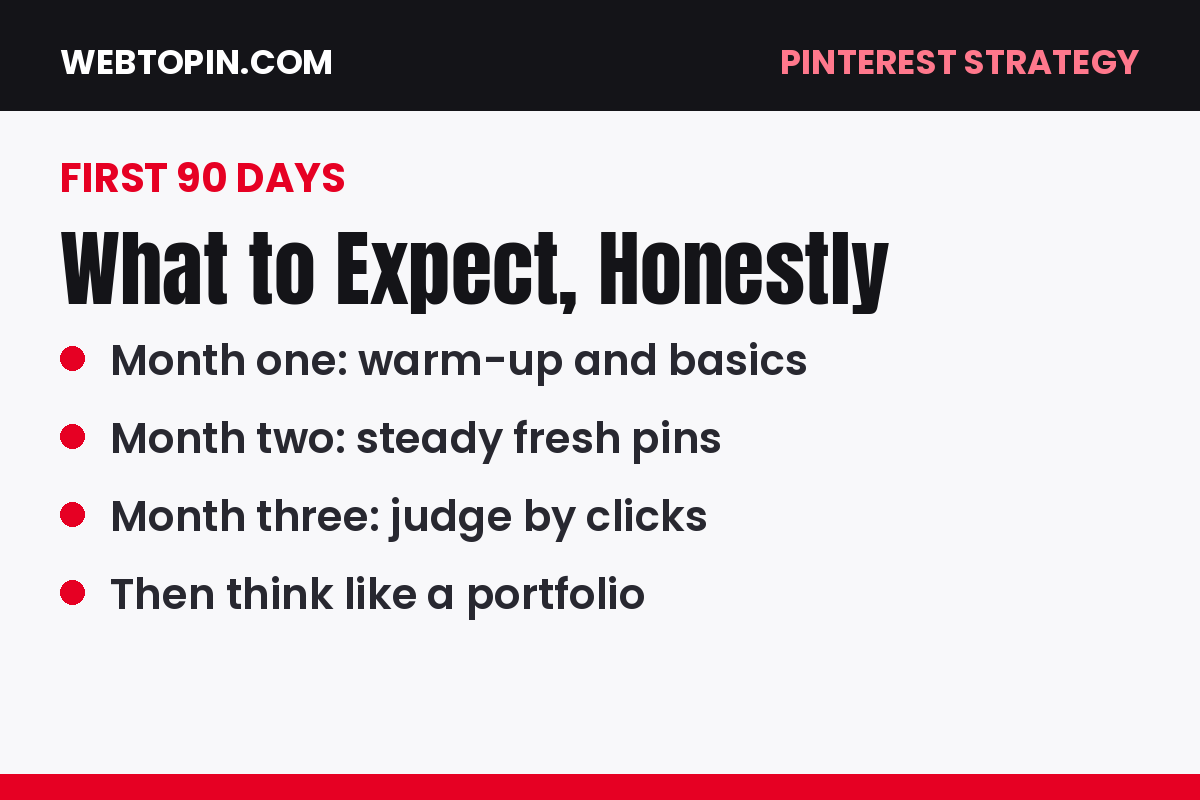
What to Expect in the First 90 Days
Account two will feel slower than account one did — partly because it is new, and partly because you now know what “good” looks like. Judge it the way you would any launch: steady browsing and pinning behaviour, impressions building first, outbound clicks following as its boards fill with well-matched pins. Keep its pace inside the same realistic daily rhythm you would give any young account — our breakdown of how many pins per day a new blog should post applies to a second account almost word for word. By the end of the first quarter you should know whether it is becoming a real second engine or a distraction to close.

Frequently Asked Questions
Can two Pinterest accounts link to the same blog?
Yes — one website can legitimately be promoted by more than one account, for example accounts serving different audiences. What matters is behaviour: distinct boards, fresh pin designs, independent rhythms and no mirrored bulk activity between them.
Should the second account be in the same niche?
Usually, yes — an adjacent audience in the same broad niche is the strongest play, because your blog already has the content depth to serve it. A completely unrelated niche on the same blog is rare; more often that deserves its own site first, and its own account after.
How will I know if the second account was a mistake?
By its numbers and its cost. If, after a full quarter of consistent work, it produces a fraction of the first account’s clicks while consuming much of your time, close it or park it and reinvest in the winner. Portfolios are pruned, not just planted.

Your Next Step
Score yourself against the four readiness signs today. If any sign fails, your real next step is on the first account, not a new one. If all four pass, write the one-sentence job description for account two, build its own small topic map, and start it slowly, separately and patiently. Scale is a reward for a system that already works — earn it in that order.